
Top-Rated San Bernardino Cps Lawyer Fighting To Protect Your Parental Rights in Juvenile Dependency Court


Top San Bernardino CFS Lawyer | Juvenile Dependency Defense | Free 24/7 Consult
CFS Took Your Child. The Clock Is Already Running.
If you’re reading this, something has already happened. A social worker came to your home. Your child was taken at school. Hospital staff “made a referral.” Maybe you signed a Voluntary Safety Plan. Maybe you’re being pressured to sign one now.
Here’s what you need to know before you do anything else: the Detention Hearing happens within 72 hours of removal. That’s three days. That’s your window. Whatever you do in the next 48 hours — what you say, what you sign, who you call — will shape whether your child sleeps at home this week, this month, or this year.
We can help. Right now. Call (866) 811-4255 — answered 24 hours a day, 7 days a week. The first conversation is free.
Who We Are
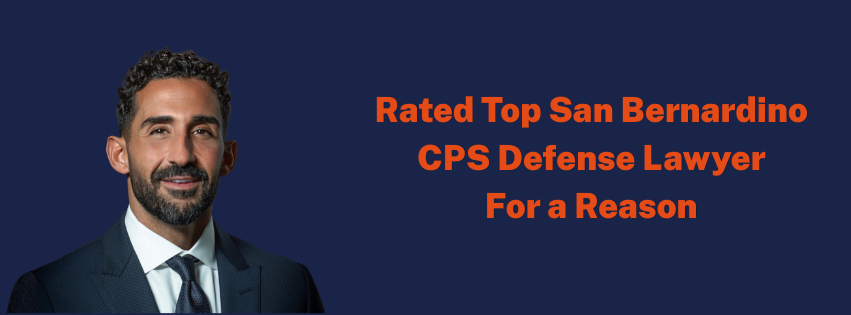
This is a CPS and CFS defense practice. Founder Mohammad “Mo” Abuershaid has personally handled more than 2,000 juvenile dependency cases across Southern California, including matters at the San Bernardino County Juvenile Dependency Court on East Gilbert Street.
He started as a public defender, court-appointed to parents who couldn’t afford lawyers. He has been on every side of dependency court — representing parents, watching social workers testify, reading thousands of detention reports, cross-examining the same County Counsel deputies and CFS supervisors who will be assigned to your case.
Most lawyers will say they “do” CFS cases. Ask them how many they’ve actually handled. Ask them how the dress code at the SB Juvenile Court is enforced. Ask them what’s in a typical detention report. The answers will tell you everything you need.
Call Now: (866) 811-4255
Available 24/7. Free consultation. Free case review.
We have an office in San Bernardino and represent parents from every part of the county — the valley, the High Desert, the mountains, and the Inland Empire.
ALL Trial Lawyers — San Bernardino Office 473 E Carnegie Dr, Suite 200 San Bernardino, CA 92408
What’s Happening to You Right Now
San Bernardino County does not call it “CPS.” It does not call it “DCFS.” Here, the agency that investigates abuse and neglect, removes children, and files dependency petitions is Children and Family Services (CFS). Every social worker, every report, every case file carries the CFS name.
CFS receives reports through the San Bernardino County Child Abuse Hotline at 1-800-827-8724, 24 hours a day. Anyone can call — neighbors, ex-partners, teachers, doctors, hospital staff, anonymous tipsters. The hotline takes hundreds of calls a day.
Mandated reporters under California Penal Code § 11165.7 — every teacher, counselor, coach, and school employee — must call when they suspect abuse or neglect. Schools and hospitals are the two most common sources of CFS referrals in San Bernardino County.
Two Major Sources of CFS Reports You Need to Know About
Schools. CFS can interview your child at school without your permission and without your presence. This is California law. By the time you find out a report was made, the interview has already happened. If a school counselor, teacher, or nurse has flagged your family, call us before any further contact happens.
Hospitals. San Bernardino County is home to several major medical facilities that frequently generate child abuse reports — including Loma Linda University Children’s Hospital (a regional referral center for the most serious pediatric cases, with specialized child abuse evaluation teams), Arrowhead Regional Medical Center in Colton, St. Bernardine Medical Center, and Desert Valley Hospital in Victorville. When a hospital files a report — especially Loma Linda — CFS often treats it as high priority, with social workers dispatched immediately.
What the Social Worker Wants From You
The CFS social worker showing up at your home wants three things:
- To get inside. Once they’re in, anything visible goes in the report — clutter, alcohol, sleeping arrangements, marks on a child. They will document what they see.
- To talk to you. Anything you say will be paraphrased in the detention report, often in language that sounds worse than what you said.
- To talk to your child alone. They can interview your child at school or even at the home without telling you first.
You don’t have to make any of this easy for them. You have rights. Most parents don’t know what those rights are until it’s too late.
What To Do Right Now (If CFS Has Contacted You)
This is the checklist. Read it before you do anything else.
1. Don’t sign anything. Not a Voluntary Safety Plan. Not a Voluntary Family Maintenance agreement. Not a Voluntary Placement Agreement. Not consent forms or releases. Once you sign, it’s part of the file forever.
2. Don’t agree to a recorded interview. Anything you say will end up quoted in the detention report. The social worker is not your friend. They are building a case file.
3. Don’t let the worker into your home without a warrant or court order. You have a Fourth Amendment right to refuse entry. Refusing is not, by itself, evidence of abuse. (How you refuse matters — be polite, be calm, but say no.)
4. Get the worker’s full name, badge number, and supervisor’s name. Write it down. You will need it.
5. Write down everything. Time of contact, what was said, who else was there, what they did, what they wanted. Memory fades fast and contradictions in CFS’s record can matter at hearing.
6. Identify a relative who could take your child. California gives relatives statutory placement preference. If your child is taken and there’s no relative on the table, they go to a foster home in the CFS pool — much harder to undo later.
7. Call us. (866) 811-4255. Before the next phone call, before the next meeting, before signing anything. We’re answering 24/7.
What Happens at San Bernardino County Juvenile Dependency Court
If a petition is filed, your case goes to the San Bernardino County Juvenile Dependency Court at 860 East Gilbert Street, San Bernardino, CA 92415. Hearings are closed to the public to protect the privacy of the child and family.
Some things to know before you walk in:
- Strict dress code, strictly enforced. No shorts, no tank tops, no undershirts worn alone, no gang attire, no bare feet. Wear what you’d wear to a job interview.
- Full security. All bags, purses, and backpacks are searched. Everyone is screened for weapons. No knives (including pocket knives), scissors, mace, or pepper spray.
- Sign in at the Superior Court Clerk’s window when you arrive. Then check in with CFS staff to get your report for the hearing.
- Tell the bailiff and clerk if you have a private attorney. This matters for case logistics.
- Cases from the High Desert (Victorville, Apple Valley, Hesperia) and the mountains may be heard at the main San Bernardino courthouse or at a nearby location depending on court scheduling. Check your hearing notice carefully.
- Phones must be silenced. No recording devices.
- Arrive 30 minutes early. Calendar moves fast.
The judge assigned to your case will likely keep the case the entire way through. The same County Counsel deputy will probably appear at every hearing. So will the same minor’s counsel and the same CFS social worker. This is a small system with repeat players, and how you and your attorney are perceived early matters all the way to the end.
The Five Hearings — In Plain English
CFS cases follow a fixed timeline. Miss a step, lose ground. Here’s what each hearing is and what’s at stake.
1. Detention Hearing (within 72 hours of removal)
The question: Does your child come home today, or stay out?
The judge reads the detention report (the social worker’s account of why they took the child) and decides whether the child stays in foster care, returns home, or is released to a relative or non-offending parent. Your attorney challenges the report, offers placement alternatives, and proposes conditions that would let the child come home.
This is the most important hearing. A child detained here usually stays out for months even if you eventually win. This is also where the court reviews whether the emergency removal was even justified.
2. Jurisdiction Hearing (within 15 court days)
The question: Did the things CFS says happen actually happen?
This is the trial. CFS has to prove its allegations under WIC 300 by a preponderance of the evidence — meaning more likely true than not. You can fight it (a “contested jurisdiction trial”) or submit. Submitting feels easier in the moment and is sometimes correct strategy. Other times, contesting wins or gets the worst counts dismissed.
3. Disposition Hearing (within 10 court days of jurisdiction)
The question: Where does your child live, and what do you have to do to fix this?
The court orders Family Maintenance (child stays home with CFS supervision) or Family Reunification (child stays placed elsewhere while you do services). You get a case plan — parenting classes, drug testing, therapy, supervised visits, whatever applies.
The exact wording of the disposition order matters. “Supervised visits twice a week” vs. “supervised visits at CFS’s discretion” can mean months of difference in your life.
4. Six-Month Review and Twelve-Month Review
The question: Are you doing enough to get your child back?
The court reviews your progress every six months. CFS writes status reports. If they say good things, you move toward reunification. If they say bad things — and CFS controls what goes in them — you can lose reunification services. Most parents don’t realize there’s a problem until the twelve-month review when CFS recommends termination. By then it’s late.
5. Permanency Hearing — WIC 366.26 (if reunification fails)
The question: Does your child go up for adoption?
If reunification services are cut off, the court chooses a permanent plan. The worst outcome is termination of parental rights. There are legal arguments at this stage that have to be preserved at every earlier hearing — which is one of many reasons uncoordinated representation early in the case can hurt you at the end.
What WIC 300 Means
You’ll see “WIC 300” on every document CFS gives you. It stands for California Welfare and Institutions Code Section 300 — the law that lets the juvenile court take over a child’s care.
CFS has to allege a specific subdivision. Most San Bernardino County cases involve:
- WIC 300(a) — child suffered or risks serious physical harm from a parent
- WIC 300(b) — failure to protect (most common; covers substance use, domestic violence, mental health, unsafe homes)
- WIC 300(c) — serious emotional damage
- WIC 300(d) — sexual abuse
- WIC 300(e) — severe physical abuse of a child under five (very serious; can bypass reunification)
- WIC 300(g) — no provision for support
- WIC 300(j) — abuse of a sibling (one child harmed = court can take all of them)
Each subdivision has different defenses, different consequences, and different reunification rules. Knowing which one is being used against you is step one.
“What Should I Do If…” — The Real Questions
“A CFS social worker is at my door right now.”
Stay calm. Open the door but don’t step aside. Ask the worker their name, badge number, and supervisor. Ask if they have a court order or warrant. If no court order and no documented emergency, you can decline entry — politely. Tell them you’ll respond after speaking with an attorney. Then close the door and call us at (866) 811-4255.
“They already took my child. What now?”
Find out: which CFS office took the child, where the child is being placed (call the CFS hotline at 1-800-827-8724), and when the Detention Hearing is scheduled (within 72 hours, at SB Juvenile Court on East Gilbert Street). Identify any relative who might be able to take the child. Call us at (866) 811-4255 before that hearing.
“They want me to sign a Voluntary Safety Plan. Should I?”
No — not until an attorney reviews it. Voluntary plans can keep you out of court, but they can also become evidence against you later. Once you sign acknowledging “risk to the child,” CFS can quote that language back to you for months. Call (866) 811-4255 before you sign anything.
“My child is at Loma Linda Children’s Hospital and a social worker is there.”
This is high-priority for CFS. Loma Linda has specialized child abuse evaluation teams that work directly with CFS and law enforcement. Cases originating from Loma Linda are often investigated aggressively. Call us immediately at (866) 811-4255 before answering any substantive questions.
“My child was interviewed at school without my consent. Is that legal?”
Yes — under California law, CFS can interview a child at school without parental notice. By the time you find out, the interview has already happened. The content of that interview will be in the detention report. The legality of any subsequent removal can be challenged at the Detention Hearing.
“I’m in the High Desert (Victorville/Apple Valley/Hesperia). Where is my hearing?”
Most San Bernardino County dependency cases are heard at the main San Bernardino Juvenile Court on East Gilbert Street. Some High Desert cases may be heard at a nearby location depending on scheduling. Read your hearing notice carefully, and confirm the location with your attorney.
“Will I get a court-appointed lawyer?”
Yes, if you can’t afford one. The court appoints counsel for indigent parents at the Detention Hearing. Appointed counsel typically meets you for the first time minutes before the hearing starts. There’s simply no time for them to prepare. This is why a lot of parents who can afford private representation choose it.
“How long does a CFS case last?”
Typically 6 to 18 months from removal to closure if reunification works. Cases that resolve at jurisdiction without removal can close in a few months. Cases involving termination of rights last longer.
“How much does a private CFS lawyer cost?”
It depends on the case. We discuss fees transparently in the free consultation. Some cases are simple. Some involve months of court appearances. Call (866) 811-4255 to discuss yours.
“Can I see my child while the case is open?”
Yes. Visitation is required, almost always supervised at first. The frequency and conditions are set by the court. The quality of your visits matters — visit reports go into CFS’s status reports.
“Will I lose my parental rights at the first hearing?”
No. The Detention Hearing only decides where the child stays during the case. Termination, if it ever happens, comes much later — at a 366.26 hearing, after reunification has been tried and ended.
“Will the case affect my immigration status?”
It depends. Dependency case files are confidential, but information can move between agencies in some circumstances. If you have any immigration concerns, raise them with us up front so we can coordinate strategy.
“Will the case affect my criminal record?”
Sometimes. If criminal charges are filed alongside the dependency case (domestic violence, child endangerment, drug charges), what you say in dependency court can be used in criminal court and vice versa. ALL Trial Lawyers handles both — which is one reason families with parallel cases come to us.
“What if I don’t agree with what the social worker wrote about me?”
Challenge it through the court process — cross-examination, written objections, and your own evidence. Telling the social worker you disagree, calling their supervisor, or arguing with them in person almost always makes things worse.
“Can I move out of California while my case is open?”
Generally no. Children in dependency proceedings can’t be moved out of state without court approval, and parents leaving California during a case can be characterized as “fleeing” or unwilling to engage in services.
Cities and Communities We Serve in San Bernardino County
San Bernardino is the largest county by area in the contiguous United States. We represent parents from every corner of it.
Inland Valley: San Bernardino, Rialto, Fontana, Colton, Loma Linda, Highland, Redlands, Yucaipa, Grand Terrace, Bloomington
West End / Inland Empire: Rancho Cucamonga, Ontario, Upland, Chino, Chino Hills, Montclair
High Desert: Victorville, Apple Valley, Hesperia, Adelanto, Phelan, Oak Hills, Lucerne Valley, Helendale, Wrightwood, Pinon Hills
Morongo Basin: Yucca Valley, Twentynine Palms, Joshua Tree, Morongo Valley, Landers
Mountain Communities: Big Bear Lake, Big Bear City, Lake Arrowhead, Crestline, Running Springs, Blue Jay, Sugarloaf
East Desert: Barstow, Needles, Lenwood, Yermo, Newberry Springs
Most San Bernardino County dependency cases are heard at the San Bernardino Juvenile Court, regardless of which part of the county you live in.
Why Parents Call Us First
Because we actually know this courthouse. SB Juvenile Court has its own rhythm, its own dress code enforcement, its own bench officers. We know which judges read every word of the detention report, which hallway conversations matter, which County Counsel deputies will negotiate before a hearing and which won’t.
Because Mo has handled 2,000+ of these cases. Not “child custody cases” or “family law cases.” Specifically dependency cases. There are not many lawyers in the Inland Empire who can say that honestly.
Because we answer the phone. Including nights, weekends, and holidays. CFS doesn’t keep business hours, and neither do we.
Because we cover the whole county. From the High Desert to Big Bear to the Inland Valley, geography is not a problem. We’ve handled cases originating from every CFS regional office and every major hospital in San Bernardino County.
Because we don’t push every case to trial — and we don’t submit every case at jurisdiction either. The strategy fits the facts. Sometimes that means trial. Sometimes it means a deal that gets your child home faster.
Because we coordinate with criminal defense if needed. Many parents in dependency court are also facing criminal charges. We handle both, in-house, so the strategy is consistent.
Call Now — (866) 811-4255
The first conversation is free. We answer 24/7. The longer you wait, the fewer options you have.
ALL Trial Lawyers — San Bernardino CFS Defense 473 E Carnegie Dr, Suite 200 San Bernardino, CA 92408 (866) 811-4255
Or send us a message through the contact form. We respond fast. But if your child has been taken, call. Don’t fill out a form. Call.
Contact Us
Fill out the contact form or call us at (866) 811-4255 to schedule your free consultation.


